
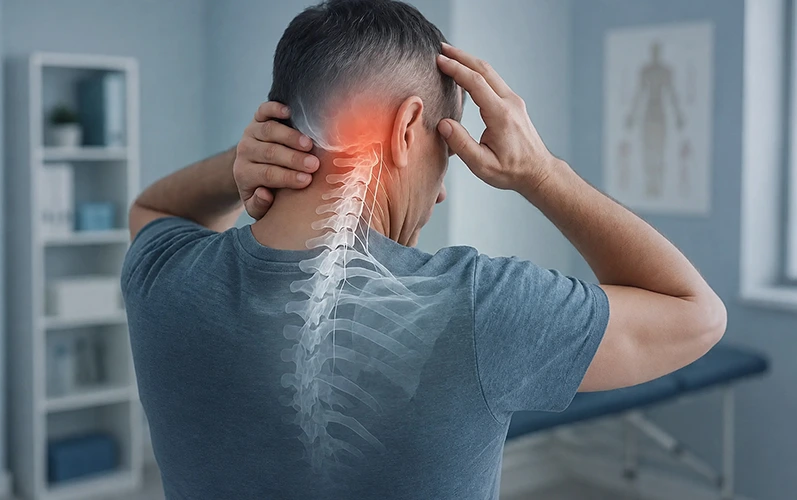
Neck pain and migraines are closely related issues, as for some people, discomfort in the neck may be related to migraines and show up as one of their symptoms. However, you may also have migraines from poor posture or muscle tension in the neck and shoulders. A sedentary lifestyle, wrong sleeping position, or any kind of physical stress can also lead to neck pain.
If you are having migraines, you should take them seriously and discuss them with a medical professional.
According to clinical data published by the National Library of Medicine, “The average time recorded in the calendars of migraine patients was 83.54 days (99.45%) for headache and 72.23 days (85.99%) for neck pain.
National Library of Medicine reports say, “Episodic migraine exhibited widespread hypersensitivity in the cranio-cervical region.”
It is proven that neck pain can be associated with migraine. More than 80% of people with migraine can have migraine-related chronic neck pain. For some people, neck pain may trigger a migraine attack.
Many people have right- or left-sided neck pain when a migraine triggers. It is one of the common symptoms of migraine.
Key Takeaways:
- Neck pain and migraine occur in close association because they use the same network of nerves in your body. They are so linked that sometimes neck pain acts as the trigger or a symptom of the migraine itself.
- The location and pattern of your neck pain matter. A proper clinical assessment helps identify the underlying cause and guides the most effective treatment.
- Most people can manage migraine-related neck pain with the right combination of physiotherapy, posture correction, strengthening exercises, and other evidence-based treatments tailored to their condition.
What is the Connection between Neck Pain and Migraine?
1. Nerve Connection and Sensitivity: Sometimes cervical nerves in the upper back and the face/head (trigeminal system) converge in the brainstem. This sensory feeling can feel like head pain, or many people perceive it to be a migraine. Pain or increased nerve sensitivity in the neck can sometimes feel like head pain, and vice versa.
2. Neck pain as a Migraine Symptom: 50% of patients who come for head pain report feeling neck stiffness or pain at the same time as their migraine trigger.
3. Neck pain as a Trigger or Comorbidity: People, especially those with a sedentary lifestyle, often experience neck problems. It typically happens due to muscle tension or poor posture. Cervical pathology is also one of the common reasons for neck pain. Such patients may tend to develop migraine in the future, or if they already have migraine, the frequency of pain attacks can increase.
When Does Migraine-Related Neck Pain Occur?
The neck and head connect through the same nerve pathway. The craniocervical region (the upper neck area), is connected to your mouth, jaw, and head. That’s why any injury or pain in this area passes on through the nerve network to the whole area.
This is one reason why treating the neck can help reduce certain headaches. Many people with headaches often experience neck pain at the same time.
We have seen in these cases that neck pain co-occurs with migraine.
However, when does neck pain become a major symptom of migraine? Most cases in our clinic have shown that pain in the neck area is often related to chronic migraine.
We can share what we’ve noticed in our clinical practice. People with chronic headaches often have neck stiffness or pain as well.
Some believe the neck pain is the main cause, while others develop neck pain after the headache starts.
Rather than making assumptions, we perform a detailed assessment. We have found: Neck pain can appear 24–48 hours before the headache.
It occurs during the prodrome (pre-headache) phase, headache phase, and postdrome phase.
This is one reason many experts believe neck pain is often a symptom of migraine rather than a trigger.
Is It a Migraine or a Stress (Tension) Headache?
You can also have neck pain from a stress headache. You will feel tightness and stiffness in the upper neck muscles. You may notice a dull, pressure-like ache that spreads across both sides of your head and into your neck or shoulders.
When the muscles around your neck and scalp feel tense, you can feel a sharp headache. Remember: when did you last feel this way? Is it after spending long hours at a desk?
Skull muscles can also contract due to heavy emotional strain or anxiety. Poor posture, or holding your head in the same position for too long, can also be the reason.
Unlike a migraine, the pain is usually not throbbing. It is less likely to be accompanied by nausea or sensitivity to light and sound.
What is The Treatment for Migraine-Related Neck Pain?
| Treatment Option | How It Helps Migraine-Related Neck Pain | Best For |
|---|---|---|
| Daily Exercise | Keeps the neck mobile, improves blood flow, and reduces muscle stiffness. | Mild to moderate neck pain and long-term prevention |
| Strengthening Exercises | Builds strength in the neck, shoulder, and upper back muscles to reduce strain. | People with muscle weakness, poor posture, or recurring pain |
| Stretching | Relaxes tight muscles and improves flexibility and range of motion. | Neck stiffness and muscle tightness |
| Posture Correction | Reduces stress on the neck by improving sitting, standing, and workstation habits. | Office workers, students, and people who spend long hours on devices |
| Physiotherapy | Uses evidence-based exercises and hands-on techniques to improve movement and reduce pain. | Ongoing or recurrent migraine-related neck pain |
| Deep Tissue Massage | Relieves muscle tension, improves circulation, and helps reduce stiffness. | Tight neck and shoulder muscles |
| Chiropractic Care | May improve joint mobility and reduce neck discomfort in appropriate patients after assessment. | People with neck joint dysfunction (when clinically appropriate) |
| Medication | Helps manage migraine attacks and relieve pain or inflammation. | Moderate to severe migraine symptoms |
| Injections | May provide pain relief when conservative treatments have not been effective. | Persistent or severe cases under specialist care |
Take Control of Your Pain Today
If you are struggling to manage both migraine and neck pain and don’t know what is causing what, the great news is you won’t have to. A professional assessment can reveal if your neck pain is a symptom of migraine, a trigger, or a distinct problem that requires medical attention.
At our Toronto pain relief clinic, we take an evidence-based approach to headache and neck pain management. We offer a range of non-invasive treatments, including physiotherapy, manual therapy, deep tissue massage, chiropractic care, and personalized training programs, to help relieve migraine-related neck pain and improve your quality of life.
If headaches and neck pain are interfering with your job, sleep, and ability to function normally, the help is right here.
Schedule an appointment with us today, and we will develop an individualized treatment plan to help you live a pain-free, well-functioning life. Stop letting chronic headaches and neck stiffness disrupt your work, sleep, and daily routine.
