
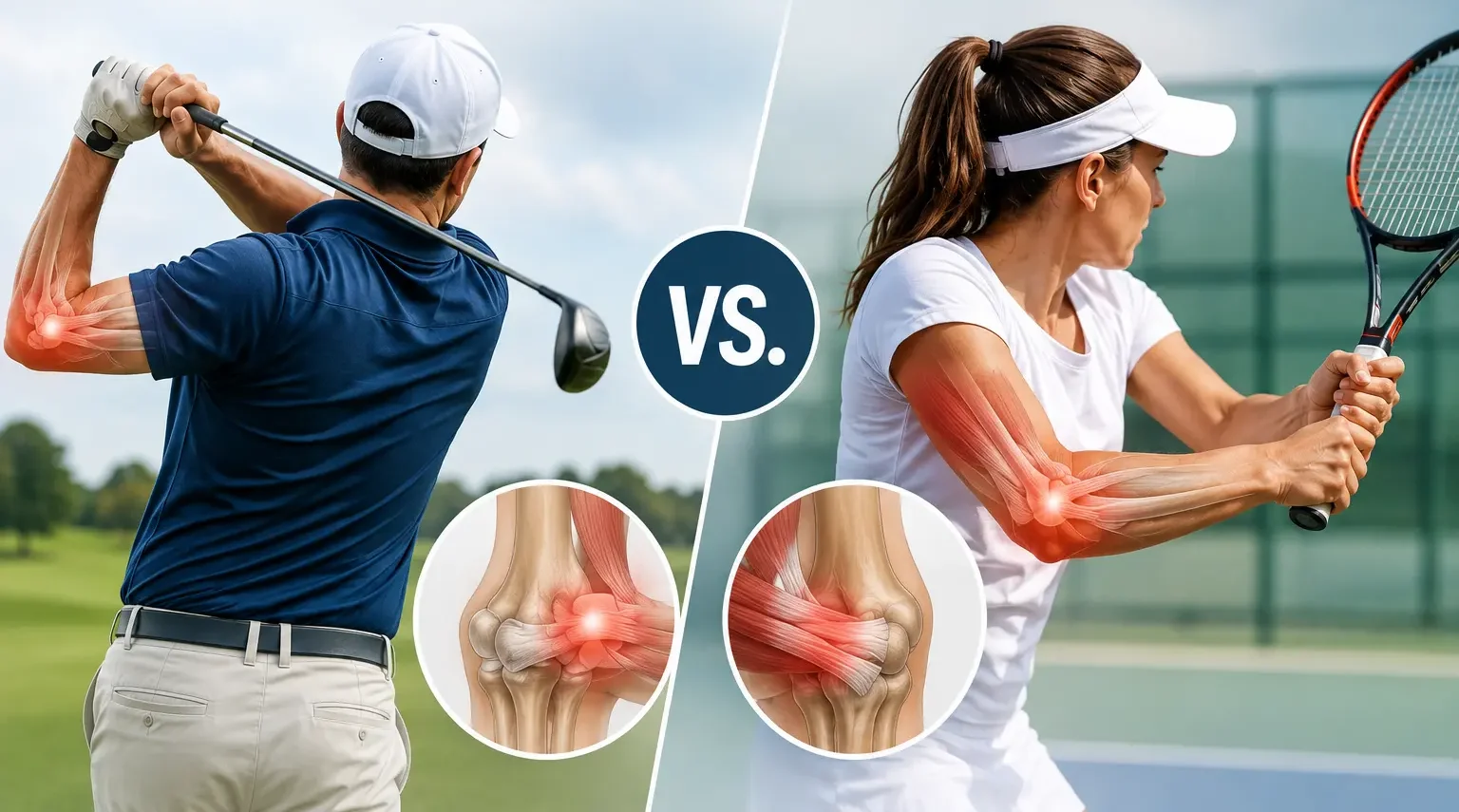
If you have pain around your elbow, you may wonder whether it is golfer’s elbow or tennis elbow. The names can be confusing, but golfer’s elbow and tennis elbow are two different conditions. Patients feel similar discomfort through pain; however, the cause, affected area, or patterns are different.
Golfer’s elbow or medial epicondylitis affects the inside of the elbow. It affects the tendons that attach to the inside of the elbow and control wrist and finger bending.
On the other hand, Tennis elbow, or lateral epicondylitis, affects the outside of the elbow. It impacts the tendons responsible for extending the wrist and fingers that attach to the bone.
These injuries develop from work, exercise, lifting, typing, or other repetitive arm movements.
In this guide, we’ll explain golfer’s elbow vs. tennis elbow in simple terms so you can understand the symptoms, causes, treatment options, and when to seek professional help.
Key Takeaways
- Golfer’s elbow and tennis elbow may feel similar. The primary difference lies in where it hurts—inner elbow pain points to golfer’s elbow, while outer elbow pain indicates tennis elbow.
- Most cases improve with conservative treatment, including rest, activity modification, physiotherapy, and evidence-based rehabilitation exercises.
- Early assessment and the right treatment plan can reduce pain faster, improve arm function, and help prevent the condition from becoming chronic.
- If elbow pain persists or keeps returning despite home care, consulting a physiotherapist can help identify the root cause and guide your recovery.
| Feature | Golfer’s Elbow | Tennis Elbow |
|---|---|---|
| Medical Name | Medial Epicondylitis | Lateral Epicondylitis |
| Pain Location | Inside (inner side) of the elbow | Outside (outer side) of the elbow |
| Affected Tendons | Wrist and finger flexor tendons | Wrist and finger extensor tendons |
| Common Cause | Repetitive gripping, lifting, or wrist bending | Repetitive gripping, lifting, twisting, or wrist extension |
| Who Is More Likely to Get It? | Golfers, plumbers, painters, weightlifters, office workers | Tennis players, carpenters, mechanics, painters, office workers |
| Common Symptoms | Inner elbow pain, wrist weakness, stiffness, tingling in the ring and little fingers | Outer elbow pain, weak grip strength, pain while lifting or turning objects |
| First-Line Treatment | Rest, activity modification, cold therapy, physiotherapy, strengthening exercises | Rest, activity modification, cold therapy, physiotherapy, strengthening exercises |
| When to See a Physiotherapist | If pain lasts for several weeks, keeps returning, or affects daily activities | If pain lasts for several weeks, keeps returning, or affects daily activities |
What Is Golfer’s Elbow?
Golfer’s elbow, also called medial epicondylitis, develops from tendon injury on the inside of the elbow. It develops from repeated wrist movements that put too much stress on these tendons.
It is common among construction workers, painters, and plumbers. Many active individuals, weightlifters, or even office workers can have Golfer’s elbow.
How Golfer’s Elbow Feel Like?
The most common symptom of Golfer’s elbow is pain. You will feel tenderness on the inside of the elbow. The pain may start gradually and become worse when you grip objects, shake hands, or lift heavy items.
You may also have difficulty bending your wrist. Some people also notice stiffness in the elbow and weakness in the hand or wrist. The tingling sensation toward the ring and little fingers is also common.
What are Some Treatment Options for Golfer’s Elbow?
Usually, golfer’s elbow symptoms go away when you give rest to your muscle. You should avoid repetitive activities or any movement that hurts the elbow.
You can also take anti-inflammatory medications under clinical guidance. You can also apply cold compression or an ice pack. It reduces pain, inflammation, and swelling naturally,
If the pain persists, you should consult an expert physiotherapist. The right evidence-based physical therapy or using a custom brace can really be helpful here.
When symptoms do not improve after several months of non-surgical treatment, you may need surgery or pain injections.
What Is Tennis Elbow?
Tennis elbow, medically, is known as lateral epicondylitis. A condition that hurts tendons on the outside of the elbow.
Just like the golfer’s elbow, tennis elbow also develops from repetitive wrist or forearm movements. Although it is called tennis elbow, most people who develop it have never played tennis.
It is a common issue among painters, carpenters, mechanics, office workers, plumbers, and anyone who repeatedly uses their forearm muscles.
How Does Tennis Elbow Feel Like?
If you have tennis elbow, you will feel pain and tenderness on the outside of the elbow.
The pain may gradually get worse. You will feel a sharp pain when gripping objects. You may also get hurt while shaking hands or lifting weights.
You may also notice weaker grip strength while doing everyday chores.
What are Some Treatment Options for Tennis Elbow?
You can recover from tennis elbow with the right treatment and activity changes.
The first and foremost thing you need is to give rest to your arm. Avoid any kind of repetitive movements. Apply cold compression therapy using an ice pack. This will help you manage pain.
You can also see a physiotherapist. This may help you improve tendon function. If you have severe symptoms, you may need a pain injection.
Doctors consider surgery when non-surgical treatments fail to give relief. However, this mostly happens in rare cases.
Golfer’s Elbow Vs Tennis Elbow [Expert Insights from Our Physiotherapists]
Our physiotherapy team has treated many patients with elbow injury/tendonitis. One of the most common questions we receive from our clients is, “Is it golfer’s elbow or tennis elbow?”
Although the symptoms can seem similar, the two conditions are different in several important ways:
- Pain Location: We always focus on the exact location of the pain to assess the pain. Pain on the inside elbow usually points toward golfer’s elbow, while pain on the outside is tennis elbow. We study the patient’s lifestyle and daily work patterns to better understand the cause of elbow tendonitis.
- Movement That Causes Pain: We ask about the triggering activities. Tennis elbow pain happens while twisting or bending. On the other hand, golfer’s elbow pain triggers gripping activities.
- Treatment Option: We create a unique pain rehabilitation plan for both conditions. We focus on pain severity and causes, then plan the treatment. We include exercises or physiotherapy, location, and reason for the pain.
Conclusion
You may not understand the fine differences in the golfer’s elbow vs. tennis elbow debate. However, when you consult a healthcare expert, you get more insights into such conditions.
The treatment options, like getting some rest or cold compression therapy, are non-negotiable for both issues.
However, when your clinical expert takes a personalized approach, you get relief faster.
Do you have the symptoms of elbow tendonitis? Consult our pain clinic in Toronto now! We offer a range of non-invasive or minimally invasive treatment plans for pain management.
